KDD 2026  ·  Half-Day Tutorial  ·  Jeju Island, Republic of Korea

Tutorial on Generative Recommendation:
Foundations and Frontiers

Xiaopeng Li1, Yejing Wang1, Honghui Bao2, Bo Chen2, Kuo Cai2, Wenlin Zhang1, Ziwei Liu1, Sheng Zhang1, Binhao Wang1, Qinglin Jia2, Qiang Luo2, Ruiming Tang2, Xiangyu Zhao1
1 City University of Hong Kong  ·  2 Kuaishou Technology
  August 09, 2026   Half-Day (3 hours)   Jeju Island, Korea

Abstract

In the current digital ecosystem, recommender systems serve as the core infrastructure for navigating large-scale content catalogs and delivering personalized services, typically following multi-stage discriminative pipelines (e.g., retrieval, ranking, and re-ranking). However, their fragmented architectures cause cascading cross-stage error propagation and suboptimal hardware utilization. This motivates a paradigm shift toward Generative Recommendation (GR). GR mitigates these issues through end-to-end unified generative modeling, optimizing for multi-dimensional preference objectives beyond local user behaviors.

This tutorial comprehensively surveys recent generative recommendation advances through a tri-decoupled perspective centered on tokenization, architecture, and optimization—the three foundational components shaping these systems. Specifically, we summarize the evolution of tokenization strategies, analyze the trade-offs of major generative architectures, and summarize the transition from supervised next-token prediction to reinforcement-learning-based strategies. Connecting these technical developments to practical deployment patterns and open challenges, we provide researchers and practitioners a foundational reference and actionable blueprint for building next-generation generative recommender systems.

Framework Overview

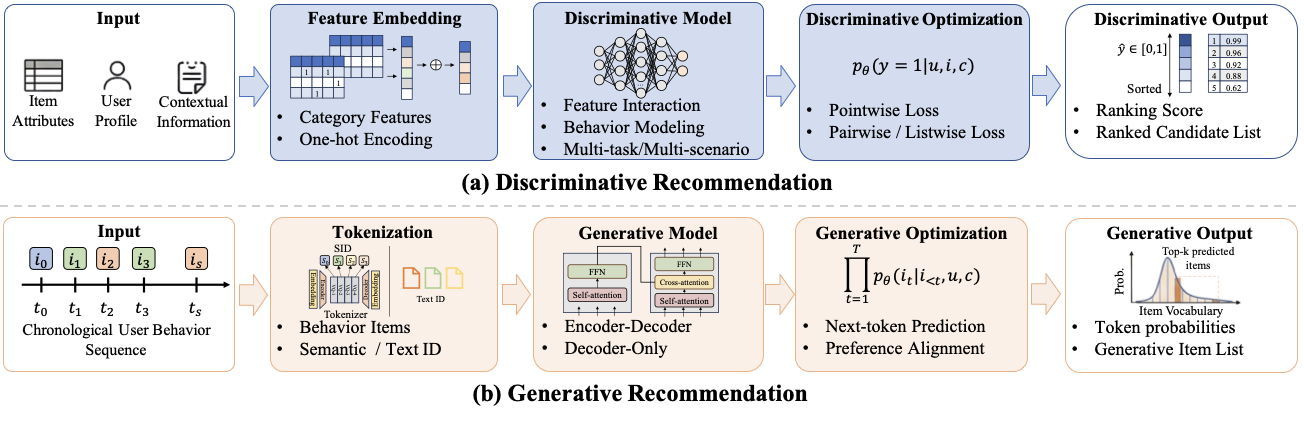
Framework overview of discriminative and generative recommendation paradigms.

Figure 1. Framework overview of discriminative (left) and generative (right) recommendation paradigms. Generative Recommendation unifies tokenization, architecture, and optimization into an end-to-end pipeline that directly generates item identifiers.

What You Will Learn

Evolutionary Trajectory

From discriminative recommendation to end-to-end generative modeling, and why this shift mitigates cascaded errors.

Tri-Decoupled Perspective

Three core dimensions: Tokenization, Architecture, and Optimization, each with its own evolving trends.

Practical Deployments

How GR systems are implemented across industrial stages (retrieval, ranking, end-to-end) and applications.

Open Challenges

Key bottlenecks and research questions, from efficiency and reasoning to interactive agents and pure content generation.

Target Audience & Prerequisites

This tutorial is designed for researchers, practitioners, and students interested in modern recommender systems, especially the transition from discriminative ranking pipelines to unified Generative Recommendation (GR) frameworks. The material is organized progressively, making it accessible to advanced students while still providing a systematic view of the design space of GR.

Expected Background

  • Basic understanding of machine learning and recommender systems
  • Common concepts in sequence modeling

Helpful (but Not Required)

  • Familiarity with Transformer-based models
  • Item tokenization and semantic identifiers
  • Generative training objectives (next-token prediction, preference alignment)

Schedule

Our tutorial will be held as a half-day (3-hour) lecture during KDD 2026. All start times are tentative and will be finalized once KDD 2026 releases the official program. Tutorial slides are available here.

Time Section Presenter
9:00—9:15 Section 1: Background & Introduction Xiaopeng
9:15—9:50 Section 2: Tokenization Strategies Xiaopeng
9:50—10:30 Section 3: Model Architecture Ziwei
10:30—10:45 Coffee Break
10:45—11:15 Section 4: Optimization Strategies Wenlin, Kaifeng
11:15—11:30 Section 5: Applications Yejing
11:30—11:40 Section 6: Challenges & Future Directions Bo
11:40—11:45 Section 7: Conclusion Bo
11:45—12:00 Q & A

  Exact session date and start time will be announced once KDD 2026 releases the official program.

Companion Survey

This tutorial is grounded in our companion survey, which provides a comprehensive review of generative recommendation through a tri-decoupled perspective — covering the evolution of tokenization strategies, generative architectures, optimization objectives, as well as practical deployment patterns and open challenges.

Survey · 2025

A Survey of Generative Recommendation from a Tri-Decoupled Perspective:
Tokenization, Architecture, and Optimization

Xiaopeng Li, Bo Chen, Junda She, Shiteng Cao, You Wang, Qinglin Jia, Haiying He, Zheli Zhou, Zhao Liu, Ji Liu, et al.

We organize recent generative recommendation advances along three decoupled yet integrated axes — Tokenization, Architecture, and Optimization — and connect them to industrial deployment patterns and open research challenges.

Citing This Tutorial

If you find this tutorial useful, please consider citing:

@inproceedings{li2026genrec,
  title     = {Tutorial on Generative Recommendation: Foundations and Frontiers},
  author    = {Li, Xiaopeng and Wang, Yejing and Bao, Honghui and Chen, Bo and Cai, Kuo
               and Zhang, Wenlin and Liu, Ziwei and Zhang, Sheng and Wang, Binhao
               and Jia, Qinglin and Luo, Qiang and Tang, Ruiming and Zhao, Xiangyu},
  booktitle = {Proceedings of the 32nd ACM SIGKDD Conference on Knowledge Discovery
               and Data Mining (KDD '26)},
  year      = {2026},
  doi       = {10.1145/3770855.3816450}
}