Proceedings of SIGIR '26

Bridging Personalization and AI: From RAG to Agent

A full-day tutorial on personalized Retrieval-Augmented Generation, user-adaptive retrieval, memory-aware reasoning, and the evolution from RAG pipelines to personalized LLM-based agents.

Pengyue Jia, Xiaopeng Li, Derong Xu, Yi Wen, Yingyi Zhang, Wenlin Zhang, Wanyu Wang, Yichao Wang, Yong Liu, Xiangyu Zhao
City University of Hong Kong Huawei Noah's Ark Lab
July 20-24, 2026 Melbourne, VIC, Australia Full-Day Tutorial

Abstract

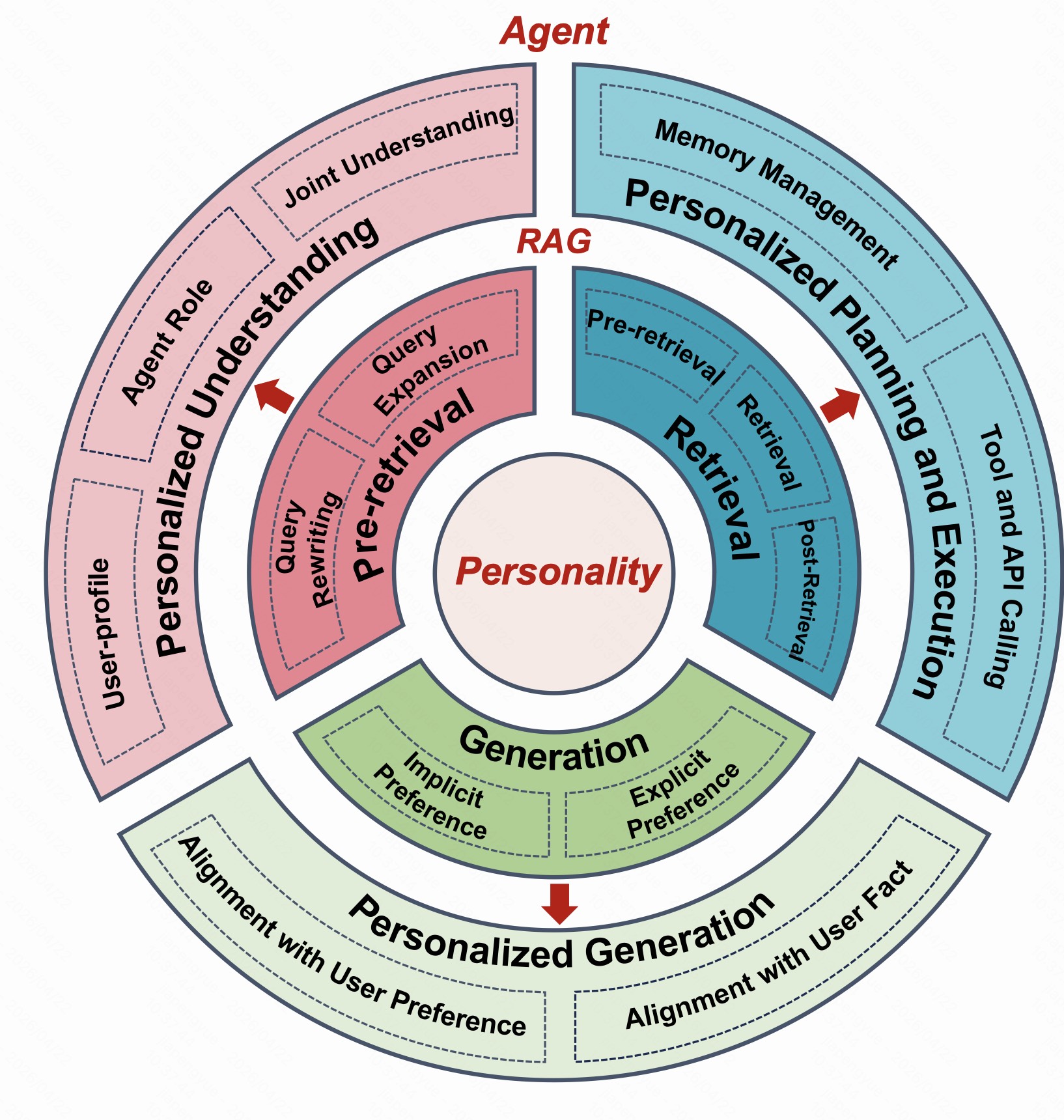
Personalization is becoming a core capability of modern AI systems. It enables systems to adapt their responses and behaviors according to individual users' preferences, contexts, and goals. Recent research has focused on Retrieval-Augmented Generation (RAG) and its development toward more advanced agent-based frameworks to improve user satisfaction in personalized settings. In this tutorial, we provide a systematic overview of how personalization can be incorporated into the three main stages of RAG: pre-retrieval, retrieval, and generation. We then extend the discussion to personalized LLM-based agents, which build on RAG by adding agent capabilities such as user understanding, personalized planning and execution, and adaptive response generation. For both RAG-based and agent-based approaches, we present clear definitions, review recent research, and summarize commonly used datasets and evaluation metrics. We also discuss key challenges, current limitations, and promising future research directions.

Tutorial Structure

Overview of the tutorial structure from personalized RAG to personalized agents

The tutorial organizes personalization from the RAG pipeline into the broader agent workflow, highlighting how user modeling, retrieval, generation, memory, planning, and execution fit into one coherent framework.

Learning Objectives

  • Understand the foundations of personalized RAG across pre-retrieval, retrieval, and generation.
  • Analyze how RAG components align with agent workflows such as user understanding, planning, execution, and response generation.
  • Identify key design trade-offs involving user modeling granularity, privacy, memory, efficiency, and robustness.
  • Explore emerging directions including continual personalization, multimodal personalization, and scalable deployment.

Schedule

Time Session Topics
09:00-09:20 Introduction to RAG and Agent Overview of RAG, agentic RAG, and tutorial organization.
09:20-09:50 Personalization in RAG and Agents Problem formulation and foundations of personalization.
09:50-10:30 Personalization in Pre-retrieval Task formulation, query rewriting, and query expansion.
10:30-11:00 Coffee Break Break.
11:00-11:50 Personalization in Retrieval Task formulation, indexing, retrieval, and post-retrieval.
11:50-12:30 Personalization in Generation Generation from explicit preferences and implicit preferences.
12:30-14:00 Coffee Break Break.
14:00-15:00 From RAG to Agent Relationship between RAG and agents, personalized understanding, planning, execution, and generation.
15:00-15:30 Evaluation and Datasets Personalization evaluation metrics, datasets, and benchmarks.
15:30-16:00 Coffee Break Break.
16:00-16:45 Challenges and Future Directions Open problems, limitations, future opportunities, and conclusion.
16:45-17:30 Panel Discussion and Interactive Q&A Open research discussion, academic and industry perspectives, and audience questions.

Target Audience

This tutorial is intended for researchers, practitioners, and AI enthusiasts who are exploring personalization in RAG and agent-based systems.

It is particularly relevant to attendees working on information retrieval, recommender systems, LLM applications, conversational AI, search, and interactive intelligent systems.

Prerequisites

Participants are expected to have a basic understanding of machine learning and information retrieval.

The material is structured to remain accessible to advanced undergraduate students while still being useful for industry professionals and researchers seeking a deeper understanding of personalized RAG and agentic systems.